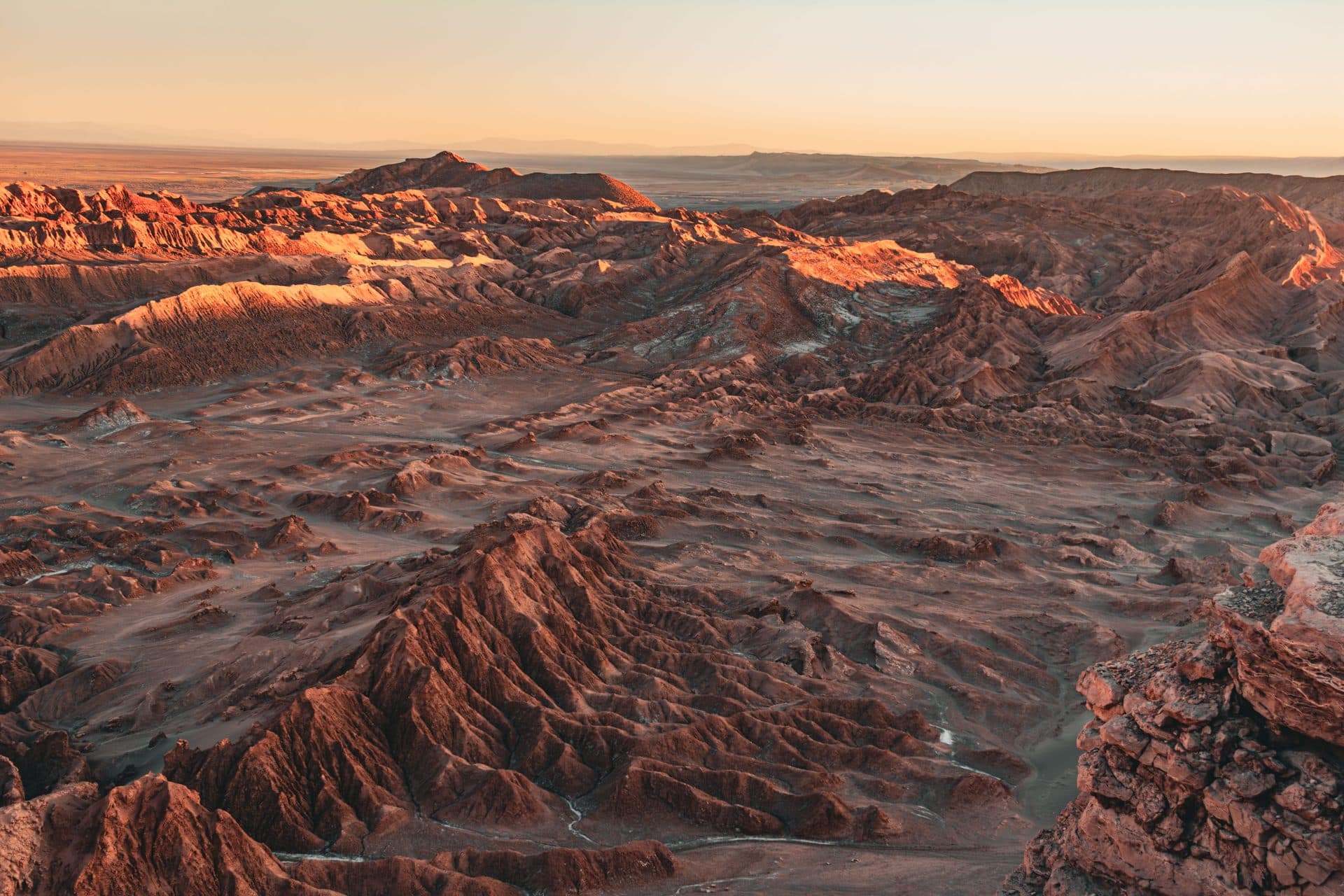
Chile (Atacama)
Chile · South America
The best time to visit Chile (Atacama) is January, February, March, October, November, and December. In summer, daytime highs average 27°C (81°F), with peaks around 29°C (84°F); in winter, nights average 3°C (37°F), dropping to around -2°C (28°F) on the coldest. During the best travel months, the sun shines up to 12 hours per day — ideal for sightseeing and outdoor activities.
Chile (Atacama) – What you should know
The Atacama in northern Chile is among the driest deserts on Earth, and the station shows it: from April to November only a few millimetres fall on average, at times less than 1 mm (< 0.1 in) a month. Most trips are based in San Pedro de Atacama at around 2,400 m (7,874 ft). The air is extremely dry (around 12–16% humidity in late winter and spring), the sun shines ten to thirteen hours a day on average, and the UV index peaks around 10 in October and November.
The difference between day and night temperatures is large. In high summer daytime highs average 25–26°C (77–79°F) and nights around 12°C (54°F); in winter highs average 19°C (66°F), nights around 3°C (37°F), and on the coldest nights from June to August just below 0°C (32°F). Excursions to the El Tatio geysers at around 4,300 m (14,108 ft) start before sunrise and are much colder than in town. Because of the altitude, many people find breathing hard at first; a day or two of acclimatisation and plenty of water help.
January and February are the time of the so-called Altiplanic winter: thunderstorms from the east bring around 47 mm (1.9 in) on five rain days in February, can close roads and cancel tours. Anyone wanting fixed programmes therefore does better to travel in October and November or in March. For stars the Atacama, with clear, dry air and almost no light pollution, is one of the best destinations; nights are darkest around new moon.
Climate Overview
| Jan | Feb | Mar | Apr | May | Jun | Jul | Aug | Sep | Oct | Nov | Dec | |
|---|---|---|---|---|---|---|---|---|---|---|---|---|
Ø day, range from coolest to warmest dayØ dayrange | 26° (79°)20– (68–)29 (84) | 25° (77°)19– (66–)29 (84) | 25° (77°)21– (70–)28 (82) | 24° (75°)18– (64–)26 (79) | 21° (70°)16– (61–)23 (73) | 19° (66°)14– (57–)22 (72) | 20° (68°)13– (55–)23 (73) | 21° (70°)15– (59–)24 (75) | 23° (73°)17– (63–)26 (79) | 25° (77°)19– (66–)27 (81) | 26° (79°)22– (72–)29 (84) | 27° (81°)23– (73–)29 (84) |
Ø night, range from coldest to warmest nightØ nightrange | 13° (55°)9– (48–)16 (61) | 13° (55°)9– (48–)15 (59) | 12° (54°)8– (46–)14 (57) | 9° (48°)4– (39–)13 (55) | 6° (43°)1– (34–)9 (48) | 4° (39°)-1– (30–)7 (45) | 3° (37°)-2– (28–)7 (45) | 4° (39°)-1– (30–)8 (46) | 7° (45°)1– (34–)11 (52) | 8° (46°)4– (39–)12 (54) | 10° (50°)6– (43–)13 (55) | 12° (54°)8– (46–)15 (59) |
☀️Sunshine | 12h UV 10 | 12h UV 10 | 12h UV 10 | 12h UV 9 | 11h UV 8 | 11h UV 8 | 11h UV 8 | 11h UV 9 | 12h UV 10 | 13h UV 10 | 13h UV 10 | 13h UV 8 |
🌧Rain Days | 3d25mm (1.0") | 5d47mm (1.9") | 2d11mm (0.4") | 0d4mm (0.2") | 0d3mm (0.1") | 0d3mm (0.1") | 0d3mm (0.1") | 0d4mm (0.1") | 0d0mm (<0.1") | 0d1mm (<0.1") | 0d0mm (<0.1") | 1d3mm (0.1") |
Best travel timeØ = average · small figures = range: coolest–warmest day / coldest–warmest nightClimate data 2005–2025 · Source: ERA5 + station data
Travel Tips
From January to December, UV levels in Chile (Atacama) reach 10 — very high on the WHO scale. High-SPF sunscreen and shade around midday are essential.
September offers great weather in Chile (Atacama) with fewer tourists and lower prices — ideal for those who want to avoid the peak season crowds.
The travel year in Chile (Atacama)
December – March
Summer in the desert: the days are long, it is warm by day and the temperature drops quickly in the evening. Sunset trips to the Valle de la Luna are popular now, and peak season means full accommodation. In January and February thunderstorms from the highlands can cancel tours and close roads.
April – August
Cool, dry desert winter: the sun shines clearly by day, it freezes at night and the air is drier than almost anywhere else. The starry sky is breathtaking and visitor numbers are low. Anyone visiting the El Tatio geysers should bring warm clothing, a hat and gloves.
September – November
Spring brings the best conditions for excursions: it gets warmer, there is almost no precipitation and the days lengthen. The sun is strong, so sun protection is a must. Salt flats, lagoons and flamingos are easy to reach now, and the main season begins without yet being crowded.
Events & Festivals
June
- Fiesta de San Pedro y San Pablo· 29 June
San Pedro de Atacama's patron saint festival begins with mass in the white adobe church dating from the 17th century. Musicians, dancers and townspeople then carry the statue of Saint Peter in procession through the village to the main square.
Frequently Asked Questions
- When is the best time to visit Chile (Atacama)?
- The best time to visit Chile (Atacama) is January, February, March, October, November, and December. These months offer the most favourable combination of sunshine, temperatures, and low rainfall.
- How warm does it get in Chile (Atacama)?
- In summer, daytime highs in Chile (Atacama) average 27°C (81°F), with peaks around 29°C (84°F); in winter, nights average 3°C (37°F), dropping to around -2°C (28°F) on the coldest.
- How much rain does Chile (Atacama) get?
- Chile (Atacama) has a relatively even rainfall pattern with an average of 1 rain day per month. The driest months are September, October, and November.
Best Travel Time by Vacation Type
🏙️
City Trip
Pleasantly mild, not too hot
JanNovDec