Guadeloupe
Guadeloupe · North America
The best time to visit Guadeloupe is February and March. In summer, daytime highs average 32°C (90°F); in winter, nights average 21°C (70°F), dropping to around 18°C (64°F) on the coldest. During the best travel months, the sun shines up to 9 hours per day — ideal for beach and outdoor activities.
Guadeloupe – What you should know
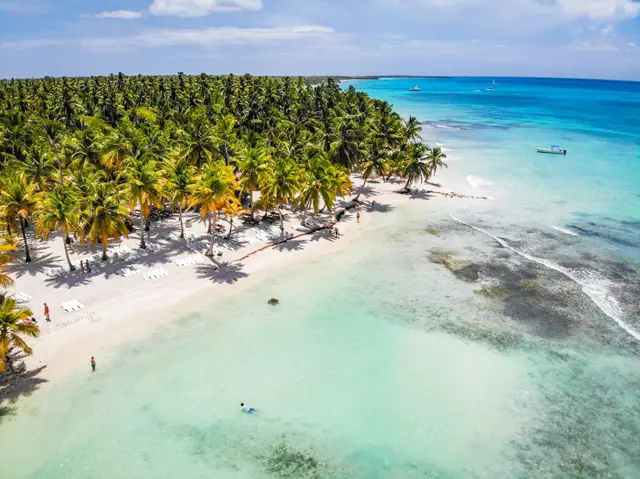
Guadeloupe is not a single island but a butterfly-shaped archipelago: Basse-Terre in the west is mountainous and covered in rainforest, with the volcano La Soufrière as its high point, while Grande-Terre in the east is flat, with sugar-cane fields, limestone cliffs and the beaches around Saint-François and Le Gosier. Add Marie-Galante, Les Saintes and La Désirade. The mountainous side catches the trade-wind clouds and is markedly wetter than the flat east.
The calmest months are February and March: daytime highs average around 28–29°C (82–84°F), about 65–75 mm (2.6–3.0 in) of rain on 8 days, 9 hours of sunshine and a sea of around 26°C (79°F). From April rainfall rises to just over 120 mm (4.7 in), and from July to 135–195 mm (5.3–7.7 in) with 12 to 14 rain days. The hurricane season runs from June to November and peaks from August to October. Humidity then sits above 80%, and highs around 31°C (88°F) feel correspondingly muggy.
The appeal lies in the mix: hikes to the Carbet Falls and through the national park, diving in the Cousteau Reserve off Basse-Terre, swimming coves on Grande-Terre and day trips to Marie-Galante and Les Saintes. Anyone wanting to combine hiking and swimming is best served in February and March. For a beach holiday alone, December and January are also good, with just under 90 mm (3.5 in) of rain, though at 18°C (64°F) the coldest nights are noticeably fresher than the rest of the year.
Climate Overview
| Jan | Feb | Mar | Apr | May | Jun | Jul | Aug | Sep | Oct | Nov | Dec | |
|---|---|---|---|---|---|---|---|---|---|---|---|---|
Ø day, range from coolest to warmest dayØ dayrange | 29° (84°)26– (79–)29 (84) | 29° (84°)26– (79–)30 (86) | 29° (84°)26– (79–)30 (86) | 30° (86°)27– (81–)31 (88) | 31° (88°)28– (82–)31 (88) | 31° (88°)28– (82–)32 (90) | 31° (88°)28– (82–)32 (90) | 32° (90°)29– (84–)32 (90) | 32° (90°)28– (82–)32 (90) | 31° (88°)28– (82–)32 (90) | 30° (86°)27– (81–)31 (88) | 29° (84°)27– (81–)30 (86) |
Ø night, range from coldest to warmest nightØ nightrange | 21° (70°)18– (64–)24 (75) | 22° (72°)18– (64–)23 (73) | 22° (72°)18– (64–)24 (75) | 23° (73°)19– (66–)25 (77) | 24° (75°)21– (70–)26 (79) | 25° (77°)22– (72–)27 (81) | 25° (77°)23– (73–)26 (79) | 25° (77°)23– (73–)27 (81) | 25° (77°)22– (72–)26 (79) | 24° (75°)21– (70–)26 (79) | 23° (73°)20– (68–)25 (77) | 22° (72°)18– (64–)24 (75) |
☀️Sunshine | 9h UV 8 | 9h UV 8 | 10h UV 9 | 10h UV 9 | 10h UV 9 | 10h UV 9 | 10h UV 9 | 9h UV 9 | 9h UV 9 | 9h UV 8 | 8h UV 7 | 9h UV 6 |
🌊Water Temp | 27° (81°) | 27° (81°) | 27° (81°) | 28° (82°) | 28° (82°) | 29° (84°) | 29° (84°) | 29° (84°) | 30° (86°) | 29° (84°) | 29° (84°) | 28° (82°) |
🌧Rain Days | 10d88mm (3.5") | 8d64mm (2.5") | 8d74mm (2.9") | 9d123mm (4.8") | 9d104mm (4.1") | 9d111mm (4.4") | 12d136mm (5.4") | 13d177mm (6.9") | 13d193mm (7.6") | 14d198mm (7.8") | 13d151mm (6.0") | 11d93mm (3.7") |
Best travel timeØ = average · small figures = range: coolest–warmest day / coldest–warmest nightClimate data 2005–2025 · Source: ERA5 + station data
Travel Tips
From February to October, UV levels in Guadeloupe reach 9 — very high on the WHO scale. High-SPF sunscreen and shade around midday are essential.
April offers great weather in Guadeloupe with fewer tourists and lower prices — ideal for those who want to avoid the peak season crowds.
The travel year in Guadeloupe
January – March
The friendliest time on the butterfly archipelago: the air is drier, highs sit at 28 to 29°C (82 to 84°F) and the nights are mild. On Basse-Terre the rainforest trails are at their best, while Grande-Terre's calm beaches beckon. Carnival makes the towns lively.
April – June
Spring brings more rain, but also plenty of green. Sunny hours stay generous at around nine a day, the waterfalls carry more water, and the beaches empty out. The air turns noticeably muggier and the sea reaches almost 28°C (82°F).
July – October
Heat, mugginess and heavy showers shape the late summer. Humidity rises above 80 per cent, rain falls on nearly every other day, and the hurricane season is at its peak. The islands of Les Saintes and Marie-Galante are quiet now, and some hotels and restaurants take a break.
November – December
The island recovers from the rain and the high season gathers pace. In November the trails are still wet, while in December drier weather returns. The nights turn pleasantly fresh, and the villages start the Christmas season with Creole Chants de Noël.
Events & Festivals
February
- Carnival· variable (January to Ash Wednesday, peak in February/March)
The season starts in early January and peaks on the Jours Gras with big parades in Pointe-à-Pitre and Basse-Terre. On Ash Wednesday the Diablesses, dressed in black and white, burn Vaval, the carnival king.
August
- Fête des Cuisinières· Saturday around 10 August (Saint-Laurent)
Guadeloupe's cooks honour their patron Saint Lawrence: after mass they parade through Pointe-à-Pitre in madras dress carrying baskets of Creole dishes, followed by a feast and dancing. The festival dates back to the founding of their association in 1916.
Frequently Asked Questions
- When is the best time to visit Guadeloupe?
- The best time to visit Guadeloupe is February and March. These months offer the most favourable combination of sunshine, temperatures, and low rainfall.
- How warm does it get in Guadeloupe?
- In summer, daytime highs in Guadeloupe average 32°C (90°F); in winter, nights average 21°C (70°F), dropping to around 18°C (64°F) on the coldest.
- How much rain does Guadeloupe get?
- Guadeloupe has a relatively even rainfall pattern with an average of 11 rain days per month. The driest months are January, February, and March.
- How warm is the water in Guadeloupe?
- Water temperature in Guadeloupe ranges from 27°C (81°F) (February) to 30°C (86°F) (September). During the best travel months (February and March), the water is most pleasant for swimming.
Best Travel Time by Vacation Type
🏖️
Beach Holiday
Warm, sunny, little rain
FebMarApr
🏙️
City Trip
Pleasantly mild, not too hot
JanFebMar